

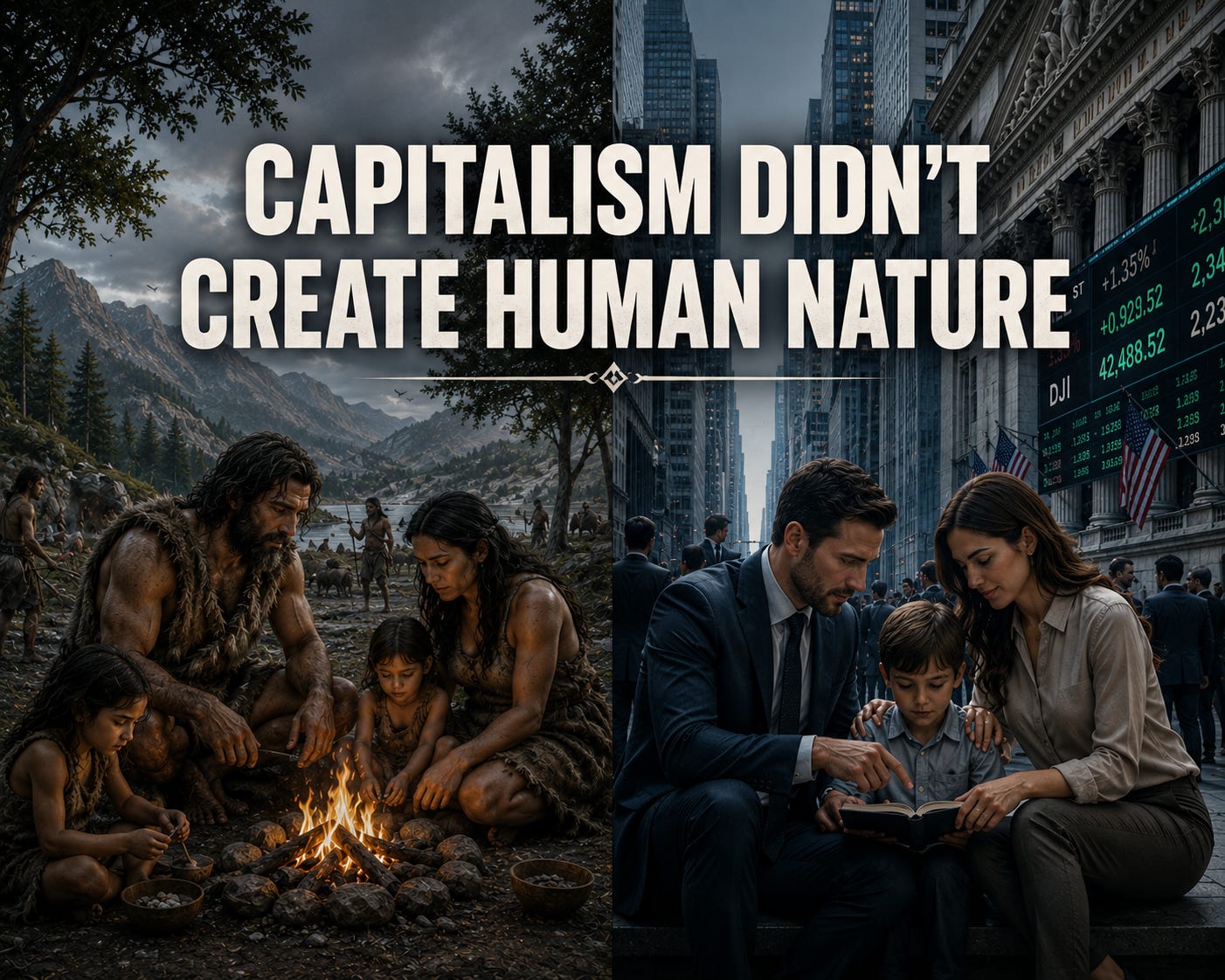
Capitalism Didn’t Create Human Nature
When Ideology Searches For Evidence

In Case You Missed Some Recent Articles
Tennessee’s Educational Paradox
According to Research, You and I Are Probably Wrong
I stumbled on an article that I won’t link because I don’t want him digitally doxed. But the summation of his piece was that couples’ issues and the rise of Mankeeping as a burden is because of capitalism’s insistence on very different definitions of normal workloads for male and female.
Here we are again, telling the same, tired story. If you’re exhausted reading about it, imagine being the one who feels the need to write about it. Oh well, here I am writing anyway. There still exists individuals who insist on blame-shifting and placing total causation on one entity for the issues that plague men, as if that one aspect of male plight will solve all social ills. News flash, there is no single solution, because there is no single problem. The problem varies, as do the solutions.
Excerpts
“I think the biggest factor behind Mankeeping is capitalism’s gendered division of labor. That’s where our so-called traditional ideas about what’s natural about men and women come from.”
So-called? So, thousands of years of evolutionary psychology means nothing? Studies on gender preferences being biological mean nothing?
Let’s take a look at such meaninglessness:
It has been established that the greater the economic development, the greater the gender differences in preferences (Falk & Hermle, 2018).
Among those differences, it has been shown that as a generalization, more males tend to choose things-oriented careers while most females tend to choose people-oriented careers (Su et al., 2009).
Yet another study, years later, turned up similar results. When looking at male and female apprentices, females had natural inclinations to occupations oriented towards people, where males had natural inclinations to occupations towards things (Kuhn & Wolter, 2022).
When looking at something more specific, like application rates and hiring rates in STEM fields, one group found that the more gender-equal the country, the greater the difference in gender representation in STEM fields, irrespective of similar achievement rates and ability among males and females (Stoet & Geary, 2018).
Yet another group noticed that when looking at all of this, it should now be expected that the vast majority of psychological sex differences should either remain unchanged or grow more pronounced with improvements in living conditions, like gender quality, education, and economic flourishing (Herlitz et al., 2025).
Biology determines much of what we like, do, and pursue. But we don’t want to let facts get in the way of a good heart-string story.
Another excerpt:
“Women were told that they’re naturally caring, relational, soft, and feminine. Men were told that we’re naturally stoic, tough, action-oriented, competitive, and masculine. These ideas were aimed at putting women in their place: in the home.”
I’m struggling to see the connection between stating biological fact and an attempt at control. But let’s review the data:
In one meta-analysis, Women scored higher in every category related to caring, tenderness, trust, nurturing, and empathy-related traits (Feingold, 1994), as well as compassion and openness in the Big Five personality traits (Weisberg et al., 2011).
In the previously mentioned study, they found women more relational (Su et al., 2009).
One study found women significantly less aggressive, supporting the idea that they are softer than males, on average (Archer, 2004).
Lastly, women showed more feminine traits across time and culture (Costa et al., 2001).
In each of these studies, they found the idea of men being naturally stoic, tough, action-oriented, competitive, and masculine true.
Maybe, just maybe, this is why women were told this. Because it is verifiably, biologically and psychologically true.
He Turns to Marx
Where it seemed to take a comical turn was when the writer was criticized for tying capitalism to relational strain. He then said that he uses Marx’s original definition of capitalism and then adds a modern Marxist Feminist’s assessment to complete his formulation.
I… I don’t even know what to say. Like… speechless. Ok, maybe not totally.
The argument isn’t rational, coherent, linear in any way. His ideas don’t even connect to one another. The closest his argument came to some form of actual reality was the unfounded fear porn of “returning to gender norms.” But even then, evolutionary psychology debunks that along with half of his article. I’ve still yet to encounter a man who wishes to return to the norms of yesteryear that place men psychologically and physically abusing women.
When I see a great writer drink ideological Kool-Aid without attempting to do his own research, it doesn’t anger me. It saddens me. This writer has talent.
But he has been told that if he feels it, it’s true. I could give 25 examples in 15 seconds that would completely debunk that notion.
Anti-capitalists fail to recognize that they’re enjoying the right to be misinformed with great confidence because some capitalist created that possibility. No socialist did it. A socialist would have already been tyrannized by his own promises. The very system he would have been supporting would have ensured he, along with everyone else under the systemic corruptive power machine were equal— equally poor and miserable.
But here, a very talented writer is almost babbling. The argument is so incoherent. I wanted to get excited about a new or different viewpoint. Instead, I was left with the fairy tale style utopian delusion that permeates the feeling > fact crowd.
I’m sorry to burst bubbles, but no economic system, nor a vile, malevolent way of viewing successful people are to blame for couple’s issues. The couple is.
We’ll get a lot further talking about a lack of third spaces than shifting blame to an inanimate economic structure. More on that in a later post. For now…
Stay Classy GP!
Grainger
References
Archer, J. (2004). Sex Differences in Aggression in Real-World Settings: A Meta-Analytic Review. Review of General Psychology, 8(4), 291-322.
Costa, P. T., Terracciano, A., & McCrae, R. R. (2001). Gender differences in personality traits across cultures: robust and surprising findings. Journal of personality and social psychology, 81(2), 322–331. https://doi.org/10.1037/0022-3514.81.2.322
Falk, A., & Hermle, J. (2018). Relationship of gender differences in preferences to economic development and gender equality. Science, 362(6412), eaas9899. https://doi.org/10.1126/science.aas9899
Feingold A. (1994). Gender differences in personality: a meta-analysis. Psychological bulletin, 116(3), 429–456. https://doi.org/10.1037/0033-2909.116.3.429
Herlitz, A., Hönig, I., Hedebrant, K., & Asperholm, M. (2025). A systematic review and new analyses of the gender-equality paradox. Perspectives on Psychological Science, 20(3), 503–539. https://doi.org/10.1177/17456916231202685
Kuhn, A., & Wolter, S. C. (2022). Things versus people: Gender differences in vocational interests and in occupational preferences. Journal of Economic Behavior & Organization, 203(203), 210–234. https://doi.org/10.1016/j.jebo.2022.09.003
Stoet, G., & Geary, D. C. (2018). The gender-equality paradox in science, technology, engineering, and mathematics education. Psychological Science, 29(4), 581–593. https://doi.org/10.1177/0956797617741719
Su, R., Rounds, J., & Armstrong, P. I. (2009). Men and Things, Women and People. Psychological Bulletin, 135(6), 859–884. https://doi.org/10.1037/a0017364
Weisberg, Y. J., Deyoung, C. G., & Hirsh, J. B. (2011). Gender Differences in Personality across the Ten Aspects of the Big Five. Frontiers in psychology, 2, 178. https://doi.org/10.3389/fpsyg.2011.00178
Related Articles:


The is a free publication. But if you really enjoyed this post and want to support our work, I would enjoy a good craft beer after writing an article. Thanks!