

Comfort for Moms, Chains for Kids
My Response to PsyPhi's article "Maternally Induced Autism"

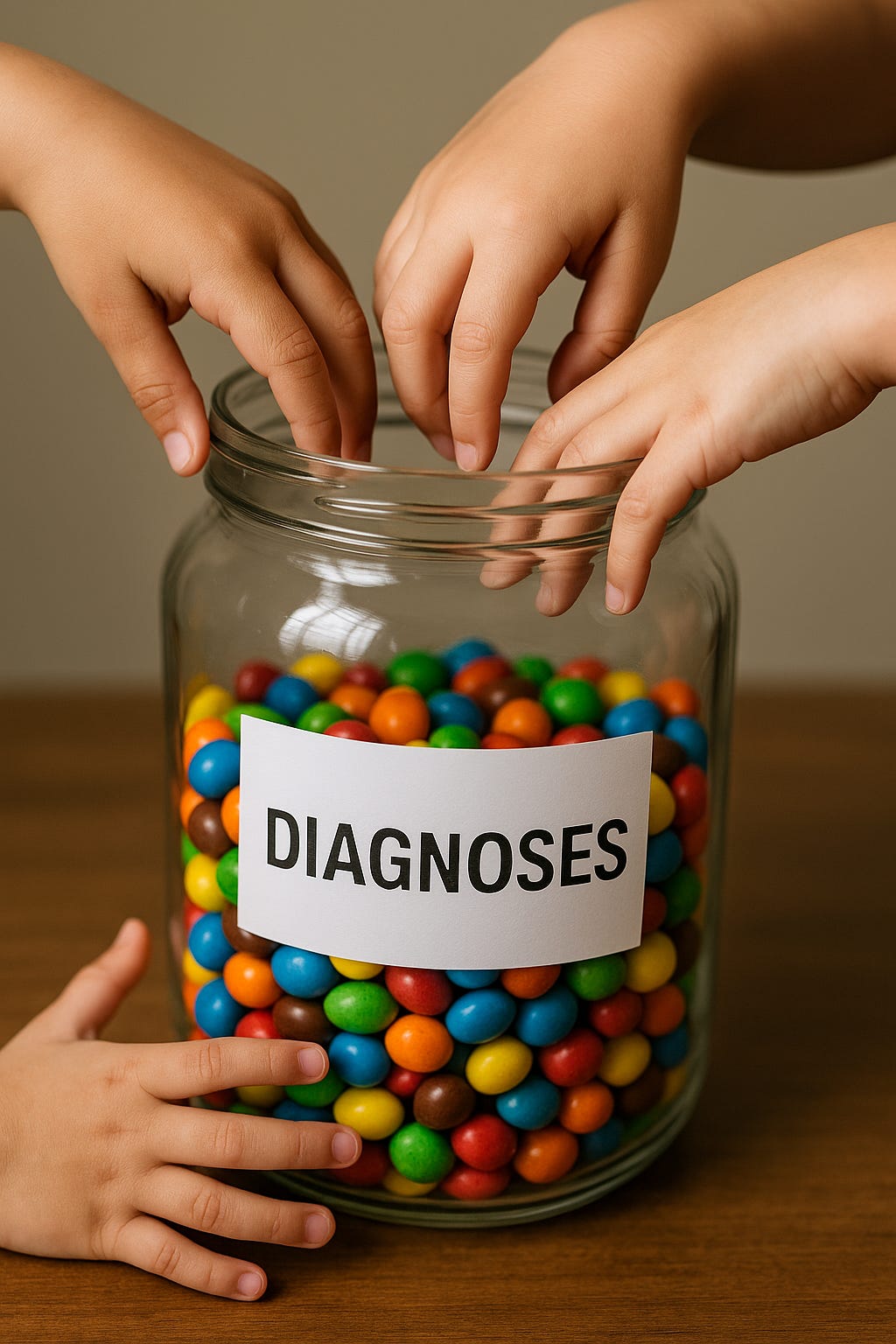
This article is a response to an article brilliantly written by PsyPhi. I want to deliver my perspective from the counseling room. The article addresses what Bitar has loosely labeled, Maternally Induced Autism. I kind of like Maternally Associated Mimicry of Autism (MAMA). But that’s the jokester in me coming out.
Here is the article I’m responding to:

I recently (this week) had a conversation with a client. She discussed her child’s autism. This young client has developed a sense of trust in me, and we share a strong therapeutic alliance. As Hannah Spier, MD recently noted, such alliances are often emphasized, sometimes even more than the tangible improvements in clients’ lives. While this observation is true, establishing a therapeutic alliance remains a necessary foundation before introducing interventions, techniques, or strategies aimed at fostering meaningful change. They don’t care how much we know until they know how much we care.
As we discussed her child’s autism, she shifted her tone suggesting that she didn’t like her child’s diagnosis because she doesn’t want her child treated any differently because of his diagnosis. I asked her how severe his symptoms are. She basically stated that he doesn’t look you in the eye, doesn’t do well in school, is particularly smart in certain areas, but is in all standard classes. All behavioral, and less likely neurological.
I asked her how she would feel if they were to find out that he does not indeed have ASD. She looked scared when I said that. She shifted:
“Well I think he probably has Asperger’s.”
I retorted:
“But you said you wanted him to be treated like everyone else, implying you did not like him having a diagnosis. But then you said you think he may still need a diagnosis.”
This screamed something to me. She enjoys the diagnosis. But why? I have found that there are three primary reasons mothers enjoy diagnoses of their children:
Their kid is extra special
They are viewed as altruistic
They are viewed with extra sympathy for their efforts and suffering
They’re Extra Special
More context: this young lady is sweet, well-meaning, and genuinely a good person. A little insecure. Tries to impress you often. But overall wants the best for everyone. So why would this good mother enjoy this diagnosis? This is where it gets good. I asked her just that.
“What about the diagnosis do you like?”
Her response:
“I think it makes him extra special.”
The error here is suggesting that he is not extra special without the diagnosis. She already stated his elevated cognition in certain arenas. And he is uniquely made. There is only one him. This alone should ensure he is special.
Altruistic
Though she didn’t allude to this, another reason mothers enjoy the diagnosis is the mother is now viewed as particularly altruistic. “Look how good I am!” Some mothers need external validation to feel good about themselves. Like their character needs to be on display to ensure a) those who mistreated them were wrong about them or b) no one will find out just how deviant they really are. Those are very different women, but I’ve met them both.
Extra Sympathy
And yet another reason mothers enjoy the diagnosis is they are viewed with extra sympathy for their struggles and suffering as a parent of a neurodivergent child. This wreaks of undiagnosed Cluster B symptoms, as PsyPhi pointed out in their article.
Labeling
Another aspect of the subject of Maternally Induced Autism worth pointing out is that labeling usually hurts the child as much as it helps, sometimes more. Research shows this:
Labeling children creates anxiety (Yang et al., 2015).
Labeling children worsens mood and reduces motivation (Mukolo, Heflinger, & Wallston, 2010).
Labeling children increases loneliness, isolation, and reduced self-esteem and confidence, thus greatly affecting their social relationships (Prizeman, Weinstein, & McCabe, 2023).
Men & ASD
Lastly, Bitar covered the paternal void exacerbating claims of neurodivergence. Studies show that children with fathers not in the home but who are directly engaged in their lives are better off than fathers in the home but either absent (due to various reasons like overworked or uninterested) or prevented from engaging in paternally instinctive roles (Coakley, 2013). The father’s absence itself contributes to ASD symptoms, through a lack of rough play, risk taking, and teasing, which produces emotional resilience (Kogan et al., 2018), as Bitar noted in this earlier article.
Based solely on this data, it is quite plausible that paternal presence indeed is a protective factor against misdiagnosis or predatory clinicians who need a new vacation home.
This is what I see in the counseling room. Avoidance. Denial. And accepting diagnosis for reasons other than science. Labels handed out like candy soothe adults, not children. My hope and my challenge is that more of us will stand up against these hollow mainstream narratives. Children’s lives are at stake, and no mom’s comfort should outweigh the truth.
Say Classy GP!
Grainger
References
Coakley, T. M. (2013). The influence of father involvement on child welfare permanency outcomes: A secondary data analysis. Children and Youth Services Review, 35(1), 174–182. https://doi.org/10.1016/j.childyouth.2012.09.023
Kogan, M. D., Vladutiu, C. J., Schieve, L. A., Ghandour, R. M., Blumberg, S. J., Zablotsky, B., Perrin, J. M., Shattuck, P., Kuhlthau, K. A., Harwood, R. L., & Lu, M. C. (2018). The Prevalence of Parent-Reported Autism Spectrum Disorder Among US Children. Pediatrics, 142(6), e20. https://doi.org/10.1542/peds.2017-4161
Mukolo, A., Heflinger, C. A., & Wallston, K. A. (2010). The stigma of childhood mental disorders: a conceptual framework. Journal of the American Academy of Child and Adolescent Psychiatry, 49(2), 92–103; quiz 198. https://doi.org/10.1097/00004583-201002000-00003
Prizeman, K., Weinstein, N., & McCabe, C. (2023). Effects of mental health stigma on loneliness, social isolation, and relationships in young people with depression symptoms. BMC Psychiatry, 23(1), 527. https://doi.org/10.1186/s12888-023-04991-7
Yang, L. H., Link, B. G., Ben-David, S., Gill, K. E., Girgis, R. R., Brucato, G., Wonpat-Borja, A. J., & Corcoran, C. M. (2015). Stigma related to labels and symptoms in individuals at clinical high-risk for psychosis. Schizophrenia Research, 168(1-2), 9–15. https://doi.org/10.1016/j.schres.2015.08.004


I wanted to share a slightly different perspective. My oldest daughter has some struggles. When she was young, I couldn’t help but notice that she didn’t always fit in with other kids her age, and that she shared some characteristics with classmates who had been diagnosed with autism. It occurred to me once or twice, “should I get this checked out?” But…she was doing well, and I really didn’t like the thought of telling her there was something wrong with the way she was. People have different personalities, right? And it’s ok to be a little quirky and socially nonconforming.
Then she started high school and the wheels came off. She decided she was really a boy (since she didn’t fit in with other girls). She was being severely bullied at school. She started cutting herself, failing her classes and refusing to do the work, had no friends, walked alone with her head down, and spent all her time online. She became a shadow of who she used to be. She asked to be evaluated for autism, so we did, and the results were that she had some traits but didn’t quite meet the criteria for a diagnosis. She was furious. She self-diagnosed with autism, ADHD, dissociative identity disorder, and transgenderism. She really wanted the labels. You could say it was for attention or to feel special but I think a more charitable interpretation is that she felt so bad about herself that she didn’t believe she was worthy of anyone’s notice or friendship as herself, so she needed to become someone different.
We changed schools, but COVID hit so it was all online. I think the damage was already done to her sense of self.
Now it’s six years later. Things are a little better but she still struggles, takes medication for depression, still goes by a male name. She’s leaned into every strange and off-putting behavior, and there’s no question in my mind that if she were evaluated for autism now she would be diagnosed. But would that help her actually become a happier and more functional person? I doubt it.
There are many, many things I wish I could go back and do differently, but one thing I wonder about is whether she’d be better off if I had gotten an autism diagnosis when she was young. Would they have taught her better social skills, and why one might want to behave in more typical ways that others don’t find off-putting? Would it have provided her with an explanation for why she felt different? Is there actually a well-defined thing called autism and does she have it?
I don’t know the answer. I can’t say that we would have had a better outcome if she’d been diagnosed. But I can also say that sometimes you think your child is capable, you try to help them be capable, but things still don’t turn out well.
I am still hopeful that she’ll grow up and be ok in a few more years. We keep trying to push her to do things we know she could do if she believed she could. Sometimes it works. Often it doesn’t.
But I think reducing this to a parent problem is oversimplifying. I wish I could go back and do many things differently, but this certainly isn’t because I or my husband wanted her to be “special” and sought out a diagnosis, nor is it because he’s not present or involved (he’s actually the stay at home parent). So just not looking for a diagnosis doesn’t necessarily solve the problem.
Thank you so much for this. I have made many of the same observations and feel so much for the many children whose problems are parent-related more than anything else.