

Another Disorder Habituating Drugs: A.D.H.D.
When Normal Behavior Becomes Diagnosis

In Case You Missed Some Recent Articles:
Comfort for Moms, Chains for Kids
Therapy is Broken and I’m Not Playing Along
I recently read an article on how ADHD is underdiagnosed. I won’t share the article or author, for obvious reasons. I’m not interested in putting this guy in the line of fire. He’s doing genuine work, with the goal of helping. And as Michael from Passion Pit recently stated, we can disagree with respect, especially if someone is genuinely trying to help those suffering. To be clear, I am not a psychiatrist nor a psychologist. I am just a mental health counselor. This is the perspective from which I write and what I see in my line of work. Note: this article is not meant to invalidate or discredit true ADHD diagnoses. It’s real. I get it. But some are out here not playing by the same rules. Time to talk about it.
The author of the article I read said he would address:
How science proves underdiagnoses of ADHD
Why ADHD is more prevalent now
Unfounded concerns about medication for treatment of ADHD
What I Can Agree On
Some of what he laid out made sense and is likely to be true. For instance, he stated ADHD is 74% heritable. I have no reason to doubt that. This places the heritability of ADHD almost as high as height (80%) and much higher than depression (35%-40%). He gave stats on stimulants, both the lack of findings that they are terrible for you and what happens when some don’t take them. For the most part, I can understand and buy this. This still lines up with a recent article I read by Michael Woudenberg that states it is possible for ADHD to be real and true, but to also be overdiagnosed. I fully agree.
The Author’s Diagnosis of Underdiagnosis
He continued with “science” that “proves” ADHD is underdiagnosed. I was left wanting. For instance, he relied on Adderall to determine diagnose prevalence. He said that 41 million Adderall prescriptions were written in 2023, severly lower than those diagnosed. He stated that 8.8% of adults had ADHD. Then linked a CDC report that showed that 8.8% of girls between the ages of 3-17 had ADHD. The latest data we have on adults diagnosed with ADHD is 6%, or 15.5 million adults. There are approximately 31 million girls between the ages of 3-17 in America. 8.8% of that is 2.7 million. Let’s take the 15% of boys diagnosed (which I highly question this validity), which is 5.4. million boys. Combine that with the 2.7 million girls, and the 15.5 million adults. That’s 23.6 million people diagnosed. Therefore, 41 million Adderall prescriptions is severely higher than diagnoses.
But let’s assume he means that the 41 million is the total number, but one person gets 12 prescriptions per year (as he alludes to in his piece), which is also doubtful because they write refills into the prescriptions, not new prescriptions. Then it’s 3.4 million people of the 23.6 million diagnosed with ADHD who are taking Adderall.
So we’re left wondering, is it one prescription, 4, 6, or 12 prescriptions? Most are 90-day refills. By that math, it would mean that almost half of those diagnosed with ADHD are taking Adderall. So that’s “severly low?” They all must be taking adderall to be considered normal?
But this doesn’t account for other medications used and behavioral treatment. And to suggest that behavioral treatment isn’t enough is patently false, I can tell you from personal experience.
This is where it all takes a severe turn for me. He never addressed:
Suppression of science
Increase in prevalence
Means of calculating underdiagnosis other than Adderall
Supression of Science
It is pretty widely known that the freedom of science is under attack. More and more reports come out each year of studies that get suppressed when they fail to meet a predictable, Marxist ideology (Soh, 2020). If the study, in any way, misaligns with identity ideology, regardless of the fact that these are objective findings, the study is suppressed, and the authors are cancelled and sometimes fired. Just ask James Nuzzo. As an unfortunate result, it is becoming increasingly difficult to trust science is presenting all angles of an issue.
Increase of Prevalence
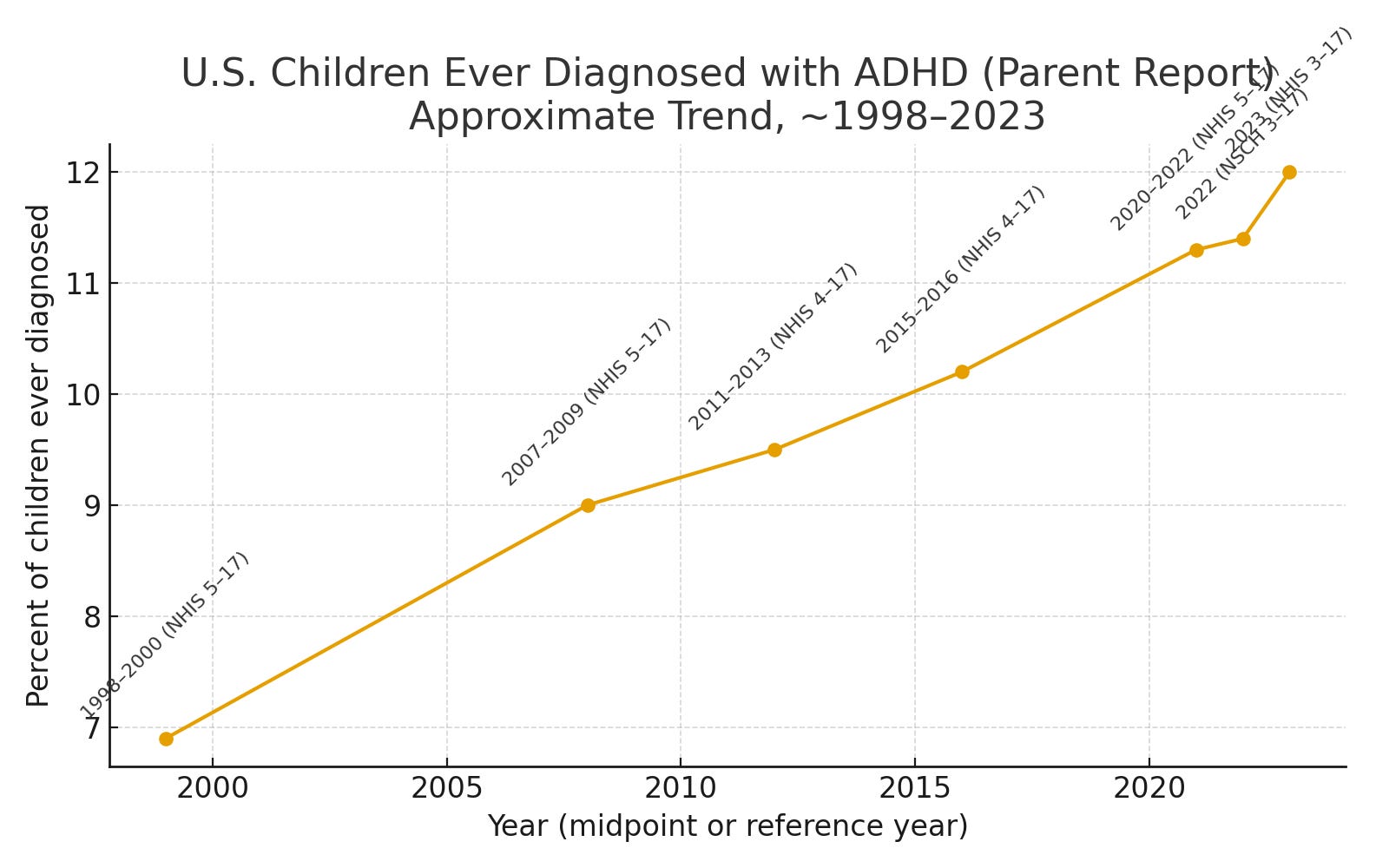
Next, this article never accounted for the sharp and distinct increase in diagnoses in the last 25 years, and especially in the last 10 years. The only explanation is “we missed it all this time.” Which does not hold up. So in 1998, 6.9% of children were diagnosed with ADHD, and in 2023, over 12% of children were diagnosed with ADHD. It doubled because we just “missed it” all this time? Or did it double because they broadened DSM criterion with each update?
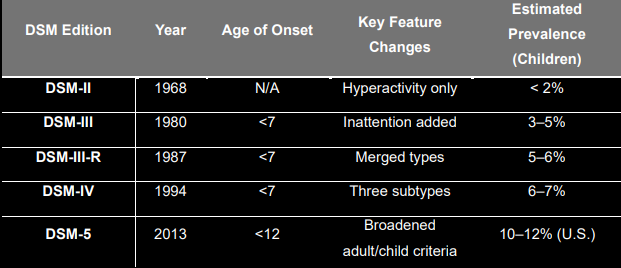
Here’s what I mean: In 1987, the DSM-III-R added “talk excessively” to the criterion (Cantwell, 1996). Then in 1994, the DSM-IV broadened the diagnosis again for ADHD, declaring “inattentive” to be pathologized to the point of medication (Polanczyk et al., 2007), which coincidentally sent a few pharma reps to Cabo on a private plane. Not to be outdone, the authors of the DSM-V said, “I’ll see you and raise you!” They raised the age of onset from 7 to 12, ensuring more medicated diagnoses (Danielson et al., 2018). They broadened the scope of adult diagnoses, doubling adults being diagnosed and spiking diagnoses among children. I know, anecdotal and not causation. I get it. But the coincidence is remarkable. And much more plausible than “we just missed it.”
Underdiagnosed or Overmedicated?
Here’s another part missing from the “underdiagnosed” club. Even if they’re right, medication isn’t always the answer, and often is a problematic solution on its best day. My bonus son (who stopped taking ADHD medication when he was 12) came to me the other night and out of the blue said, “You know, I feel like I still have ADHD, but I know how to handle it, keep the symptoms at bay, and control my impulses now after all of the things you’ve taught me. I feel… normal” You know what this says? That it isn’t merely neurodevelopmental, and maybe not even mostly neurodevelopmental. It is mostly behavioral. Which means the solution is often behavioral. So what did I teach him? I’ll give you two examples.
Example 1:
When I came into his life, he was 8. When he had something to say, he’d start yelling it in the next room as he was approaching the room he knew his mother was in. I consistently stopped him in his tracks, made him go back into the other room and reenter the room, quietly looking to see if anyone was already talking, refrain from interrupting if they are, and restate what he wanted to say. It took nearly 2 years for this to take hold of him. But he eventually got it. ADHD is a learning disorder. I watched that part of it up close. For most people, it wouldn’t take 2 years to catch on. But we got there. We created a new standard, consistently required him to meet this standard, and over time, he did. They’re Capable!
Example 2:
My bonus daughter has a 4 year old son who simply “can’t sit still.” So he and I, along with another daughter are at a restaurant. He gets on top of something and I tell him to get down. He looked at me like, “who are you?” I tell him again. He still doesn’t get down. I go pick him up, carry him to my seat, and sit him next to me. I tell him he’s not getting up again. He states his disapproval. I set a consequence if he continues. He stops… for 20 MINUTES STRAIGHT! We sat calmly and had a typical conversation. This means, he was capable, but he was never held to this standard. The food comes out, he’s fine and starts telling me how much he loves cheese. I said, “Don’t we all, my man!” They’re Capable!
Conclusion
I am open-minded. I am willing to learn. And I want to be challenged. But if the best you have is that the usage of Adderall is the “scientific proof” of underdiagnosis, forgive me if I’m not convinced. In my experience, both as a father and my clinical experience, behavioral adaptations to most symptoms indicative of societal ADHD still work better than medication. I know because I’ve witnessed it and treated it, personally. I’d now like to get back to talking about things like how pineapple should never be put on pizza.
Stay Classy GP!
Grainger
References
Cantwell D. P. (1996). Attention deficit disorder: a review of the past 10 years. Journal of the American Academy of Child and Adolescent Psychiatry, 35(8), 978–987. https://doi.org/10.1097/00004583-199608000-00008
Danielson, M. L., Bitsko, R. H., Ghandour, R. M., Holbrook, J. R., Kogan, M. D., & Blumberg, S. J. (2018). Prevalence of Parent-Reported ADHD Diagnosis and Associated Treatment Among U.S. Children and Adolescents, 2016. Journal of clinical child and adolescent psychology : the official journal for the Society of Clinical Child and Adolescent Psychology, American Psychological Association, Division 53, 47(2), 199–212. https://doi.org/10.1080/15374416.2017.1417860
Polanczyk, G., de Lima, M. S., Horta, B. L., Biederman, J., & Rohde, L. A. (2007). The Worldwide Prevalence of ADHD: A Systematic Review and Metaregression Analysis. AJP, 164(6), 942–948. https://doi.org/10.1176/ajp.2007.164.6.942
Soh, D. (2020). The end of gender: debunking the myths about sex and identity in our society (First Threshold Editions hardcover edition. ed.).
The is a free publication. But if you really enjoyed this post and want to support our work, I would enjoy a good craft beer after writing an article. Thanks!
Related Articles:


I don't think anyone who is medicated should be on medication without developing the skills that the medicatjon is supposed to help you learn better (neurons that fire together must wire together) and i think people vastly under-appreciate how much of a *mood disorder* it tends to be, thus no mere pill-popping, but a slew of approaches simultaneously
ADHD case here. I'm 51 now. I was 23 when they diagnosed me with ADD. Now, we call it ADHD. Fine. Nothing you've mentioned is offensive. You're bringing up worthy questions.
When I was diagnosed in the late 90s, most of the psychiatric profession was clueless. My psychiatrist prescribed SSRIs. I said, "No thanks," and left. Glad I did.
Recently, I tried low doses of Ritalin to see if it would help with some of the lagging ADHD characteristics that cause me grief, but it wasn't for me. I live in Mexico, where we don't have Adderall or Vyvanse, the latter of which is proving quite effective. So, I am back to what I've been doing for the last few decades.
Keeping my habits: daily resistance and cardio training, daily meditation, calendarizing everything, and a laundry list of other habits. This covers most of the holes, but I can still be an ADHD-hole from time to time. I've learned to apologize with sincerity.
Worth noting: I am one of the lucky ADHD cases for whom the above works. It's not so easy for all of us. As a coach, I have clients who simply bounce off execution. Nothing I do or say helps. For them, medication helps, but it can be tough to sort out.
But it does work, way better than SSRIs work for depression, and most of what we produce as medication. Dr. William Dodson is pretty influential on my perspective. He's done some great work talking about the good, the bad, and the ugly with meds.
Regarding your son, who stopped taking his meds. This is not talked about much, but there seems to be a number of cases where the brain is remodeled in adolescents. In such cases, they can either lower their doses or completely stop. Why it's not talked about it concerning, though, and why some of us question what's true.
What is definitely true is that this is a relatively new diagnosis and treatment. There's just a lot we still don't know. We'd all be wise to stay loose.